Photography, memory, and death
H is for HawkPhotography, memory, and death converge in Helen Macdonald’s account of her father’s camera and the records he left behind. Photography could place a protective distance between him and danger, but it also preserved the singular details of a world that would otherwise disappear. After his death, the images and notebooks do more than recall him: they reveal how looking closely had been a way of resisting erasure, and how the meaning of a kept object can change with time.
The camera as protection and witness
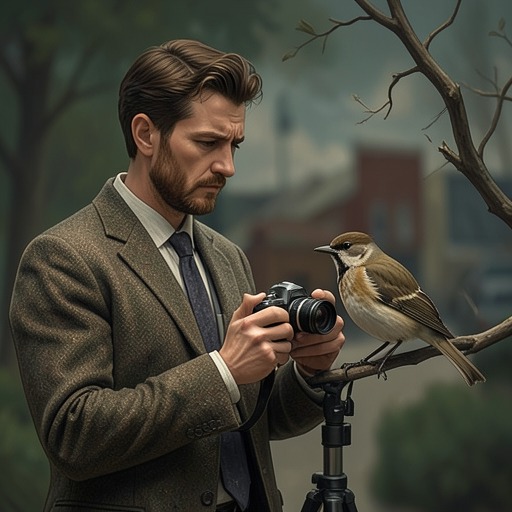
Helen Macdonald remembers her father’s term for dangerous assignments: white-knuckle jobs. He described photographing from a helicopter after its safety harness had snapped, and looking through a fish-eye lens from a frail iron rung high on Salisbury Cathedral. His method was to bring the camera to his eye and look through the viewfinder. Technical decisions about exposure, depth of field, and the hoped-for shot displaced the body’s immediate fear: the photographer no longer had to experience himself as someone who might fall.
That separation offered a defence beyond physical danger. His work also brought him face to face with accidents, train crashes, and the aftermath of city bombs. He once admitted, with sadness, that he saw the world through a lens, as though the camera had become something between him and other people’s lives. The habit that let him endure terrible assignments could also trouble him as a barrier to involvement. The camera is therefore neither simply an instrument of detachment nor an uncomplicated means of intimacy: it shields the photographer even as it records what he has witnessed.
Photographs against disappearance
After her father’s death, Helen Macdonald considers the thousands of photographs he made as records and as a bulwark against forgetting, nothingness, and death. Their subjects span private and public life: a baby placing a tiny hand in an elderly person’s palm, a fox on a woodland path as a man raises a gun, wrecked vehicles, a comet, and a prime minister wiping his brow. One photograph records the Beatles at a café on the Champs-Elysées on a cold January day in 1964, with John Lennon’s pale face beneath his fisherman’s cap. The image insists that these events happened, while making them available to memories beyond the photographer’s own.
The family albums preserve more than family likenesses. Among them are a starling with a crooked beak, hoarfrost and smoke, a cherry tree in blossom, and records of thunderstorms, lightning, comets, and eclipses. Such photographs hold the brief and particular against human forgetfulness. They also sharpen the contrast between a human life, lasting only a blink in the world’s course, and celestial events that suggest the world will continue after any one observer is gone. Preservation cannot stop time; it can make a moment visible again.
Attention and the decisive moment
Her father’s way of looking was not confined to the camera. One winter evening he returned from a press-call disheartened by a small boy who had failed to look up at the sky. In a deserted London park, beside a frozen boating lake, he had tried to draw the child’s attention to an elaborate display of ice-rings and sun-dogs: a 22-degree halo, a circumzenithal arc, and an upper tangent arc. The boy seemed uninterested. Her father remained sad that he had not seen a spectacle that would never appear in quite the same way again. The episode makes attention itself part of his legacy: seeing is not guaranteed merely because something extraordinary is present.
The idea of the decisive moment, associated with Henri Cartier-Bresson, gives this attentiveness a photographic form. A good image depends on recognizing a composition or expression as life offers it and releasing the shutter before the instant is gone. Helen Macdonald recalls one of her father’s photographs: an elderly street-cleaner, photographed from low down at pavement level, bends beside his birch-twig broom to offer a crumb to a sparrow. The bird is caught hopping to take it from the man’s bare fingers; the man’s face carries joy. The photograph preserves not only the gesture but the fleeting expression that gives it meaning.
Waiting with a hawk brings the same question of attention into the present. Helen Macdonald had hoped to see the bird lower her head and feed from her hand, but the hawk was frightened and would not eat. After a rest beneath the hood, the bird began inspecting the room instead of fixing her gaze on Helen Macdonald in fear. When she finally noticed the person beside her and jumped in surprise, the moment was not the hoped-for act of feeding, but it was still decisive: for an instant, the human observer had ceased to be all that existed in the hawk’s world. The episode distinguishes attentive looking from control over what one sees. A moment can matter precisely because it arrives differently from expectation.
Notebooks, objects, and belated understanding
Later, among her father’s bookshelves, Helen Macdonald finds six cloth-spined plane-spotting diaries. The first she opens is from 1956, when he was sixteen. Its columns record time, number and type of aircraft, remarks, and registration numbers. On 25 April he watched from 9.40 in the morning until 7 in the evening; the next day he began at 9 and continued until 9 at night. Across hundreds of pages, the careful lists name aircraft including Vickers V70 Viscounts, F-86 Sabres, and Gloster Meteors. A report of a visit to Croydon Airport itemizes Tiger Moths, Auster trainers, Taylorcraft, and de Havilland aircraft. A glued-in image and his note disputing the Russian account of a Tupolev Tu 104 show the intensity of his interest. The notebooks make his patience legible as a lifelong practice of looking and recording, not merely a lesson he had given his daughter.
Among the books she also discovers a rough piece of brown cardboard with a silver key taped to it and a short message from her father identifying it as the key to his flat. He had posted it so she could stay there while he was away; after she lost it, he had joked about her absent-mindedness and promised to have another cut. The key and its handwritten message unexpectedly call up an earlier memory of his holding her tiny hand at Stonehenge, where she had asked whether the ancient stones were a house. A family object, a remembered place, and her father’s handwriting bring separate times together without making them identical.
Holding the cardboard, Helen Macdonald finally understands the shape of her grief. Her father’s teaching about patience—waiting if one wants very much to see something—returns with a changed force: time has passed, and the grief has become something different, which she recognizes as love. She puts the card back among the books and whispers her answer to his message. The ending does not make photography or keepsakes defeat death. Instead, their preserved traces allow attention to continue after the person who first gathered them is gone.